Computer Vision Syndrome — The Early Signs Every Desk Worker Misses
On this page
- What CVS Actually Is
- Why the Early Signs Get Missed
- The Early Signs That Aren't About Your Eyes
- The Late-Afternoon Headache That Follows the Screen
- Neck and Shoulder Tightness
- Brain Fog That Doesn't Match the Workload
- Light Sensitivity in the Evening
- Avoiding More Screens After Work
- The Signs That Are About the Eyes
- Reading Speed Drops Through the Day
- Subtle Squinting and Repositioning
- Blurriness When Glancing Away
- Dryness That Worsens Through the Day
- Why These Compound
- What To Do About It
- When to See an Eye Doctor
- Building the Habit
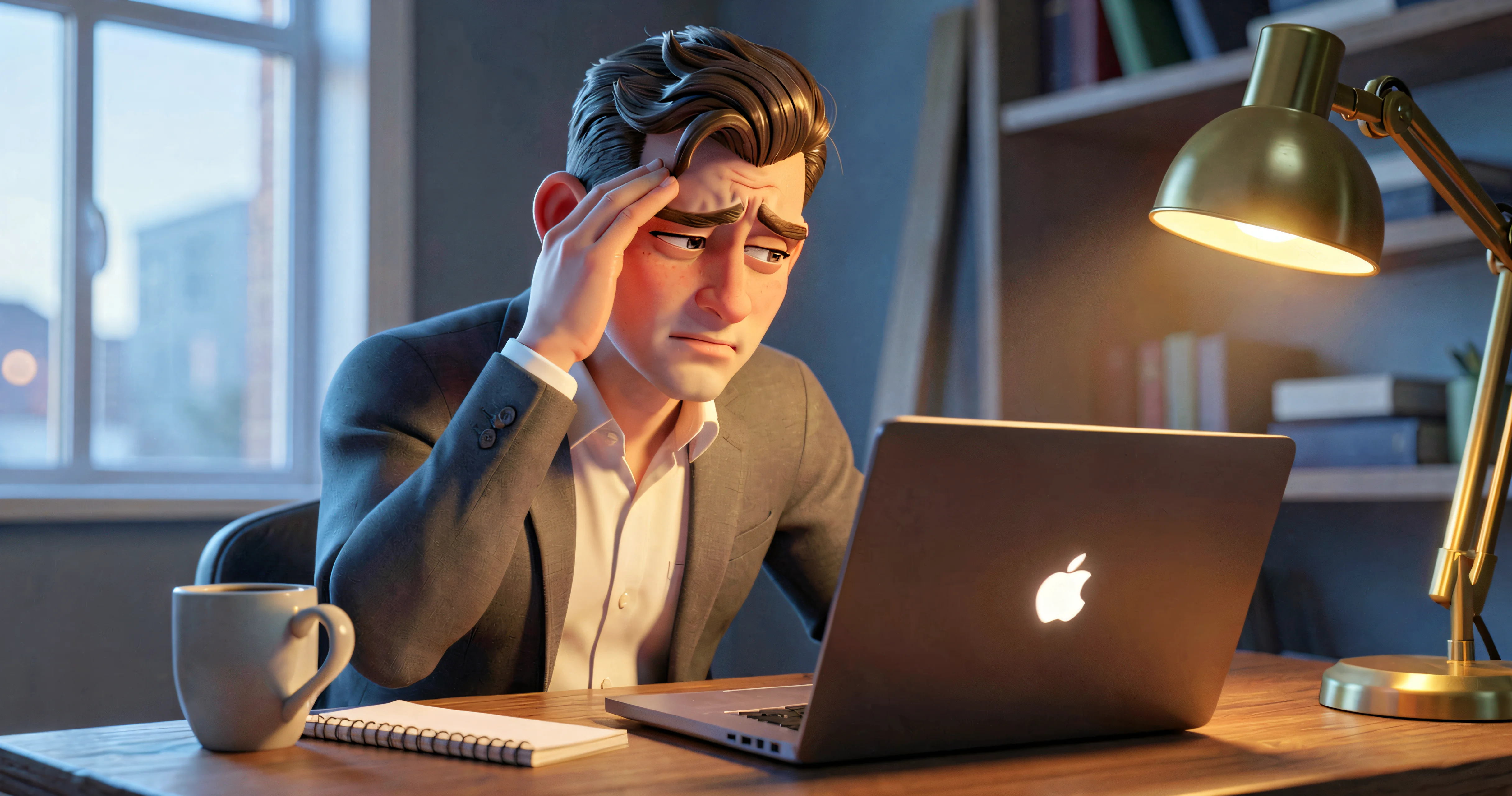
Most desk workers wait for their eyes to hurt before they take screen strain seriously. By then, computer vision syndrome — CVS, also called digital eye strain — has already been building for months. The earliest signs of CVS don't look like eye problems at all. They look like a stressful week.
The eyes complain last. The headache, the shoulders, and the mood drift complain first.
What CVS Actually Is
Computer vision syndrome is the cluster of symptoms that develops from prolonged focused work at a screen. The American Optometric Association defines it as a group of eye and vision-related problems resulting from extended computer, tablet, e-reader, and phone use. It's not a disease. It's the body responding to a task it wasn't designed for: holding the eyes locked at a fixed near distance, in a narrow visual field, for hours at a time.
Estimates put the share of computer workers reporting some CVS symptoms at somewhere between 50 and 90 percent. The wide range reflects how loose the diagnostic criteria are — CVS is a syndrome, not a single test result. If you spend more than three hours a day at a screen, you almost certainly have at least one symptom. The question is whether you've noticed it.
Why the Early Signs Get Missed
The classic CVS symptoms — burning eyes, blurry vision, dryness — are easy to attribute to the screen. People recognize them. Companies sell products for them.
The early symptoms are easier to misattribute:
- A late-afternoon headache becomes "I haven't eaten enough."
- Tight shoulders become "I slept funny."
- Brain fog becomes "this project is mentally draining."
- Light sensitivity at dinner becomes "I'm just tired."
Each of these has plausible alternative explanations, which is exactly why people dismiss them. But when they show up in the same daily pattern — building through the afternoon, peaking after a screen-heavy block, easing on weekends — the screen is the variable, not the workload.
The Early Signs That Aren't About Your Eyes
The Late-Afternoon Headache That Follows the Screen
A dull, pressing ache around the temples or behind the brow that shows up between 3 and 5 PM. It correlates more tightly with continuous screen time than with hunger or stress. The tell: it eases noticeably within fifteen minutes of stepping away from the screen, even before any other intervention.
This kind of tension-type headache is one of the most common CVS presentations. The eye muscles work harder to maintain fixed near focus than people realize. When those muscles fatigue, the strain refers outward — to the forehead, temples, and base of the skull.
Neck and Shoulder Tightness
The connection here surprises people. CVS isn't only about the eyes; it's about the head position those eyes force the body into. Most office setups have the screen slightly too high or too far. The neck cranes forward to compensate. The shoulders rise.
By the end of a working day, the trapezius is doing what feels like a low-grade plank. The next morning's stiffness traces back to the previous day's screen — not yesterday's gym session.
Brain Fog That Doesn't Match the Workload
Some afternoons feel disproportionately mentally heavy. The work isn't harder than usual; the brain just feels less responsive. Word recall slows. Decisions take longer. Switching between two open tabs feels like dragging through mud.
Visual fatigue is mental fatigue. The visual cortex consumes a meaningful share of cognitive bandwidth, and when the eyes are working hard to hold focus, the rest of the brain has less to spend. People blame the workload. The actual cost is the unbroken hours of close-distance staring.
Light Sensitivity in the Evening
A dimmer room feels comfortable. Headlights look harsh on the commute home. Indoor lighting suddenly seems aggressive at dinner. This isn't an issue with the lights — the eyes are inflamed and tired from a day of focused work, and they want darker conditions to recover.
If evening light tolerance is consistently lower than morning light tolerance, the eyes are telling you something.
Avoiding More Screens After Work
A subtler one: the gut feeling that scrolling the phone after work is exhausting, not relaxing. People who once unwound with a movie or a game start to find their attention drifting away from anything with a screen. They reach for a paperback, a walk, anything offline.
This isn't burnout in a vague sense. It's the visual system pushing back against more of the thing that just wore it out.
The Signs That Are About the Eyes
Reading Speed Drops Through the Day
Most people don't notice this consciously, but it shows up in productivity data. Reading the same email at 4 PM takes longer than reading it at 10 AM. The eyes can still do the work, but they need more time per line to maintain comprehension.
Subtle Squinting and Repositioning
The unconscious tells: leaning forward toward the screen, adjusting glasses repeatedly, tilting the head to find a better angle. These are accommodation strategies the eyes deploy to keep focus stable when the muscles are fatigued.
Blurriness When Glancing Away
Looking up from the screen, the room takes a beat to come into focus. This delay — called accommodative lag — is a hallmark of digital eye strain. Early in the day, focus shifts feel instant. Late in the day, they have a soft edge.
Dryness That Worsens Through the Day
People blink around fifteen times a minute under normal conditions. At a screen, that drops to as low as five. The tear film thins, the surface of the eye dries out, and by mid-afternoon the eyes feel sandy. Cold air conditioning makes it worse.
Why These Compound
The early signs of CVS feed each other in a feedback loop. Dryness makes focus harder, which fatigues the muscles faster, which produces more headaches, which makes the work feel heavier, which makes the breaks feel less attractive, which means the eyes keep working.
Catching CVS early means breaking the loop before the symptoms get loud enough to demand attention. By the time the eyes are visibly red at the end of the day, the syndrome is already established, and recovery takes weeks of better habits — not minutes.
What To Do About It
The fixes are well-established and unglamorous:
- Move the screen. Top edge at or just below eye level. Roughly arm's length away — about 50 to 70 centimetres. Tilt the top back a few degrees so the gaze drops slightly to read.
- Get the lighting right. Ambient light close to the brightness of the screen. No bright window directly behind the monitor. No overhead light reflecting off the screen surface.
- Blink on purpose. The body's normal blink rate plummets at a screen. A few intentional full blinks every minute or two re-coats the eye and resets the dryness clock.
- Take real breaks. The 20-20-20 rule is the standard: every 20 minutes, look at something 20 feet away for 20 seconds. The interval is what matters most. A break every hour is too late.
- Check the prescription. Many adults wear glasses optimised for distance, not for the screen's intermediate range. A small refraction shift can make all the difference.
The hardest of these isn't the technique — it's the timing. The breaks have to happen automatically, because the moment you're deep enough in the work to need one is the moment you can't be trusted to remember.
When to See an Eye Doctor
Most CVS is solved by habit. A few signs are worth a professional visit:
- Persistent blurry vision that doesn't clear with rest.
- Headaches that get worse week-over-week even with better breaks.
- Double vision, even briefly.
- A noticeable change in prescription strength in under a year.
- Eye pain that doesn't ease overnight.
These can indicate accommodation problems that need refractive correction, or — less commonly — issues unrelated to screen use that need ruling out.
Building the Habit
The break-every-twenty-minutes rule is the most cited piece of CVS advice in optometry, and the least followed. The interruption feels disruptive in the moment. The cumulative cost of skipping it doesn't.
Limited Session runs in the Mac menu bar and surfaces a full-screen break overlay at whatever cadence fits the work — 20 minutes for strict 20-20-20 compliance, 25 minutes for a Pomodoro rhythm, 50 minutes for deep-work blocks. The overlay is deliberate: a notification banner gets dismissed without thought, a full-screen card does not.
The early signs of CVS are reversible. The compounded version isn't, at least not without weeks of better habits. The cheapest moment to act is when the only symptom is a 4 PM headache that nobody can quite explain.
Related Articles
The 20-20-20 Rule Explained — And Why Most People Do It Wrong
What the 20-20-20 rule actually requires, where most people cut corners, and why the timing matters more than it sounds.
Blue Light and Eye Health — Separating Fact From Marketing
What blue light actually does to the eyes, what it doesn't, and which habits matter most.
Screen Time and Children's Vision — What Parents Should Know
How prolonged screen use affects developing eyes and what practical steps reduce the risks.
How Break Reminders Help Parents Manage Kids' Screen Time
A practical guide for parents who want their kids to take regular screen breaks without constant nagging.